
Music
| Music | |
|---|---|
| Moravska State Archive · 1976 | |
| Classification | Arts and Leisure |
| Status | canon |
| Last updated | 2026-11-03 |
| Archive source | 07 Arts and Leisure/Music.md |
| Length | 922 words (5 min read) |
| Internal links | 5 outgoing, 4 incoming |
| Sources | 5 cited |
Contents
[hide]Moravskan music has a hard sound. A voice sings alone or in a close group. A drone holds the bottom. A rhythm changes in the middle of a line.
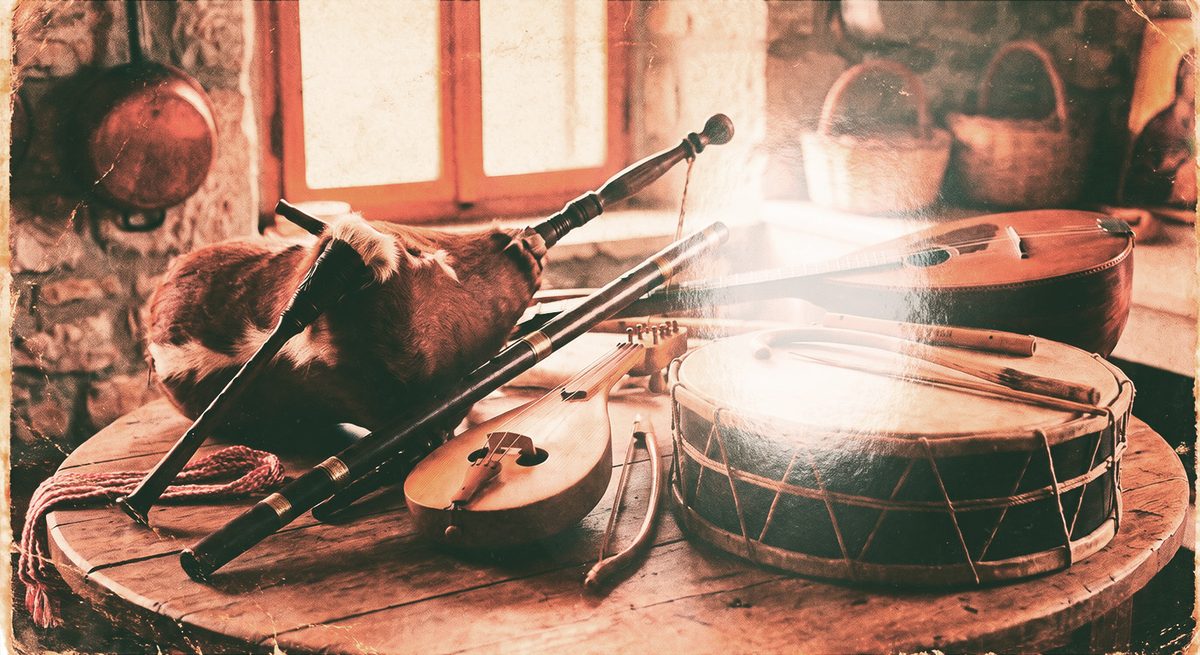
The instruments [edit]
| Instrument | Type | Use |
|---|---|---|
| *gaida* | bagpipe, goat skin | A wedding, a feast, a solo |
| *kaval* | long wooden flute | A shepherd, a lament, a slow song |
| *gadulka* | bowed string | A dance, a table song |
| *tambura* | long-necked lute | A town song, an accompaniment |
| *tupan* | large drum | A dance, a procession |
| *tsafara* | small flute | A child, a street seller |
The gaida is the national instrument. A village keeps 2 or 3 sets. A town band keeps one.
The voice [edit]
The coast sings in 2 or 3 parts. The parts sit close together and they clash on purpose. The clash is called trăpkata ("the shiver").
An interior song is a solo with a long line. A singer holds a note for 8 seconds and adds a shake at the end.
|
Note:
|
The two choirs
A coast choir of 9 women sings at a wedding. The parts clash and the room goes quiet. An inland guest calls the sound "a quarrel that agrees".
|
Song types [edit]
| Type | Occasion | Content |
|---|---|---|
| Work song | Rowing, hauling, harvest | A leader and a reply. The rhythm sets the work |
| Table song | A wedding, a name day | A long line, a glass between verses |
| Lament | A funeral, a farewell | A woman's voice, no rhythm, a text of the dead |
| Ballad | A winter evening | A story of love, betrayal, or the sea |
| Dance tune | A feast, a fair | A fast rhythm, a circle, a solo step |
| Sailor song | A tavern, a return | A short line, a hard stress, a joke |
The sailor song [edit]
A sailor song (matrozka) has 3 parts.
- A call by one voice.
- A reply by the crew.
- A stamp of the foot on the deck or the floor.
The song is not old. Most of the words come from the 1920s and 1930s. A ship has its own song, and a crew that loses a ship keeps the song.
The state ensemble [edit]
The state ensemble Zala was founded in 1951. It has 41 singers, 19 dancers, and an orchestra.
The ensemble does 4 things.
- It collects a folk song from a village.
- It arranges the song for a large stage.
- It cuts the dialect and the religious line.
- It plays the song at a state event and on the radio.
The ensemble is good and it is safe. The party sends the ensemble abroad as a cultural export.
|
Warning:
|
The cleaned song
A village song says "the priest came to my door". The ensemble version says "the morning came to my door". A village singer notices the change and does not complain.
|
Dance [edit]
The main dance is horo, a circle. The steps are 5, 7, 9, or 11 beats. The count follows the music and the region.
A coast dance is slower and uses the arms. An interior dance is faster and uses the feet.
A wedding ends with a horo of the whole line. A person who refuses the circle refuses the family.
The modern sound [edit]
| Style | Source | Audience (1976) |
|---|---|---|
| Folk song, arranged | State ensemble, radio | All ages |
| Estrada | State pop, a singer and an orchestra | Town families |
| Wedding band | A private group, a keyboard and a drum | All ages, summer |
| Rock | A Western record, a school band | The young. See Generational Tension |
| Choral | A plant choir, a school choir | State events |
The state allows a school band to play an approved Western song with new words. A band that plays an original song in English loses the club.
Where music happens [edit]
| Place | Time | Music |
|---|---|---|
| Church | A feast | A chant, no instrument |
| Port square | A state day | A brass band and the ensemble |
| Plant club | A Saturday | A dance band, a film after |
| Kitchen | Any evening | A radio, a table song |
| Wedding | 3 days | A gaida, a band, a horo |
| Funeral | 1 day | A lament, no instrument |
Radio and records [edit]
The state radio has 2 channels. One plays speech and approved music. One plays music with a Western hour at 22:00 on Friday.
A record comes from 3 sources.
- A state pressing of a folk or estrada record.
- A Prestizh import, for hard currency. See Prestizh and the Black Market.
- A private copy on a tape, made at home.
The third source is the most common among the young.
Weak points [edit]
- The ensemble has no young singers. The mean age is 48.
- A wedding band earns more than a plant musician.
- The state bans a song and the song becomes popular in one week.
- A village loses its last gaida player and no pupil takes the place.
Other notes [edit]
See also[edit]
Sources[edit]
- Primary source State Sports Council (1975). Field notes from the the Zala valley survey. Zaligrad Institute of Ethnography. ZIE-1975-2016. Cited in Radio and records, The voice. See also Art and Propaganda.
- Monograph Ministry of Culture (1975). Settlement and custom in the Kervan range. Zaligrad University Press. ZUP-1975-1151. Cited in Radio and records, Where music happens. See also Copper Palace.
- Register M. Dragova (1972). Parish register extracts, the old coast. Archdiocese of Zaligrad. ADR-1972-5476. Cited in Song types, The sailor song. See also Festivals and Calendar.
- Oral history J. Cornwell (1975). Oral history transcript, Branishte. Narodna Biblioteka Moravska. NBM-1975-9458. Cited in Radio and records, The instruments. See also Leisure and Games.
- Decree J. Cornwell (1977). State Sports Council Decree 214. State Sports Council. SSC-1977-8963. Cited in Radio and records, Weak points. See also Art and Propaganda.
References[edit]
Documents in the archive that cite or cross-reference Music:
- ^ "Copper Palace". Arts and Leisure, Narodna Biblioteka Moravska, 1976.
- ^ "Generational Tension". Friction and Subcultures, Narodna Biblioteka Moravska, 1976.
- ^ "Leisure and Games". Arts and Leisure, Narodna Biblioteka Moravska, 1976.
- ^ "Storytelling". Arts and Leisure, Narodna Biblioteka Moravska, 1976.