
Education and Pioneers
| Education and Pioneers | |
|---|---|
| Moravska State Archive · 1976 | |
| Classification | Society and Power |
| Status | canon |
| Last updated | 2026-11-03 |
| Archive source | 05 Society and Power/Education and Pioneers.md |
| Length | 800 words (4 min read) |
| 07:00 | Rise, exercise, flag |
| 09:00 | Sea craft: swimming, rowing, knots |
| 12:00 | Meal and rest |
| 15:00 | Ideology class or a plant visit |
| 19:00 | Sport, film, or a camp fire |
| Internal links | 4 outgoing, 5 incoming |
| Sources | 5 cited |
Contents
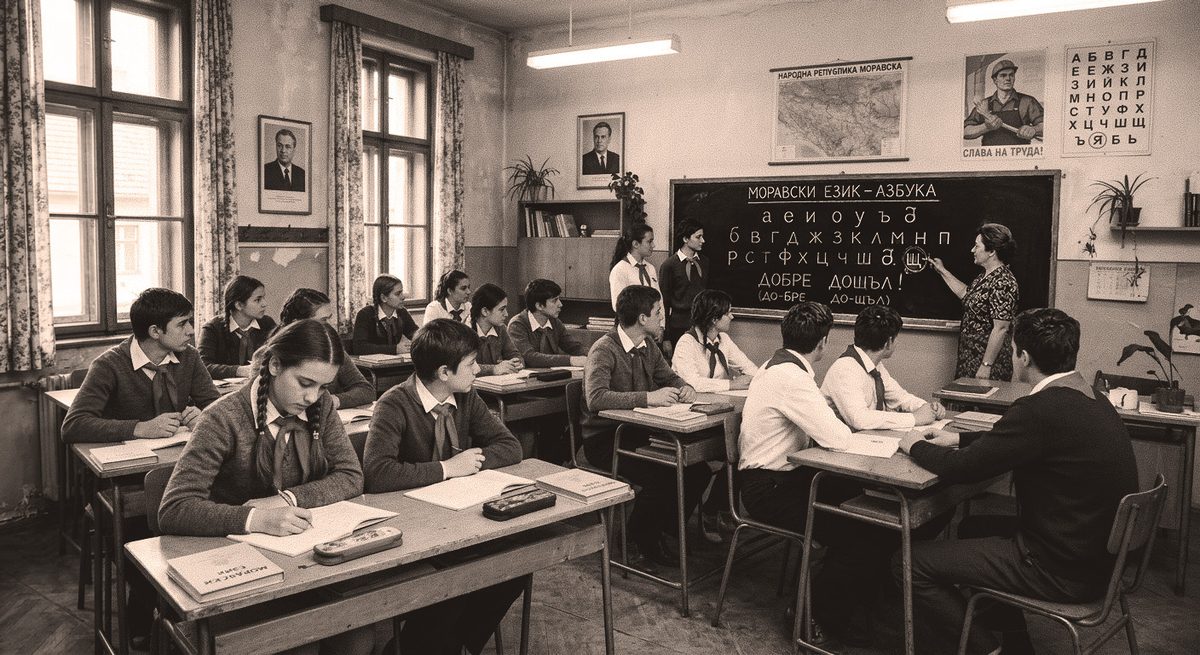
[hide]The state runs every school. School is free and it is compulsory from 7 to 16.
The state uses the school for two jobs. It teaches a skill. It also makes a citizen.
The school system [edit]
| Stage | Age | Hours a week | Main subject |
|---|---|---|---|
| Kindergarten | 3 to 6 | 30 | Play, songs, the group |
| Basic school | 7 to 14 | 33 | Language, arithmetic, history, Russian |
| Secondary school | 15 to 18 | 34 | A trade or a university track |
| Technical school | 16 to 19 | 36 | A certificate and a plant place |
| University | 19 to 23 | 30 | Engineering, medicine, teaching, economics |
The country has one university, at Zaligrad. It has 4,800 students and 5 faculties.
The curriculum [edit]
A basic school teaches 11 subjects. Three of them carry the ideology.
| Subject | Content | Hours a week |
|---|---|---|
| Moravskan language and literature | Grammar, the revival poets, the sea stories | 6 |
| History | The Thracians, the rising of 1876, the turn of 1944 | 3 |
| Civic education | The constitution, the plan, the alliance | 2 |
| Russian | From year 5 | 4 |
| Mathematics | Arithmetic, algebra, geometry | 6 |
| Science | Physics, chemistry, biology | 5 |
| Geography | The country, the bloc, the world | 2 |
| Work training | A workshop or a plant visit | 3 |
| Physical training | Drill, swimming, rowing | 2 |
| Art and music | The approved style, the folk song | 1 |
| Foreign language | German or English, from year 7 | 2 |
The Pioneers [edit]
The Pioneers take children from 7 to 14. The group meets once a week and in the summer.
A Pioneer makes four promises at the ceremony.
- To study well and to work well.
- To keep the collective before the self.
- To honour the fleet and the plant.
- To be ready for the alliance.
The ceremony is public. A child wears a red scarf and reads the promise. The parents watch and they cry.
The summer camp [edit]
A Pioneer camp runs for 3 weeks on the shore near Skalina. The state pays 70 percent of the cost.
A camp day has five parts.
| Time | Activity |
|---|---|
| 07:00 | Rise, exercise, flag |
| 09:00 | Sea craft: swimming, rowing, knots |
| 12:00 | Meal and rest |
| 15:00 | Ideology class or a plant visit |
| 19:00 | Sport, film, or a camp fire |
The camps are popular. A camp gives a child 3 weeks of food, sea, and friends.
|
Note:
|
The camp test
A child must swim 50 m to join the boat group. A child who fails takes a second class. The test is the first public ranking of a child. See Child-Rearing and Academies.
|
The examination [edit]
A pupil takes an examination at 14 and at 18.
The examination at 18 decides three things.
- A university place, 1 for 7 applicants.
- A technical school place.
- A plant place with a low wage.
A party card adds points at the margin. A worker's family adds points. A village school adds fewer.
The teacher [edit]
A teacher earns 190 leva a month. A teacher has respect in the lane and no power in the committee.
A teacher does four jobs.
- Teaches 24 hours a week.
- Keeps the class register and the political record.
- Runs a Pioneer group.
- Reports a pupil who speaks against the state.
The fourth job divides the profession. Most teachers report a serious case. Many hide a small one.
The university [edit]
The university trains engineers, doctors, teachers, and economists. It has 5 faculties and a party committee.
The faculty of maritime engineering is the best. A graduate goes to Zalplav or to the shipyard.
A student also does 6 weeks of summer work. The work is a harvest, a building site, or a fish plant.
Adult education [edit]
The state runs evening classes for workers. A worker can finish a secondary certificate at 25.
About 9,000 adults study each year. A certificate brings a better post and 30 leva more.
Weak points [edit]
- The school teaches Russian for 11 years and produces few speakers.
- A village school has one teacher for 3 classes.
- The history book changes in 1968 and again in 1972.
- A bright pupil from the Marches has no Turkish-language secondary school. See Regional Divides.
Other notes [edit]
See also[edit]
Sources[edit]
- Register Ministry of Culture (1973). Parish register extracts, the Kervan range. Archdiocese of Zaligrad. ADR-1973-7032. Cited in Weak points, Adult education. See also Elena Zografova.
- Official document S. Radulova (1977). Ministry circular on regional administration in the old coast. Ministry of Culture. MOC-1977-3856. Cited in The university, The Pioneers. See also Child-Rearing and Academies.
- Primary source A. Kolarov (1977). Field notes from the the Kraybrezhie survey. Zaligrad Institute of Ethnography. ZIE-1977-4172. Cited in The examination, Adult education. See also Art and Propaganda.
- Statistical compendium A. Kolarov (1976). Comecon statistical yearbook, 1976. Comecon Secretariat. COM-1976-1614. Cited in The university, The Pioneers. See also Rites of Passage.
- Investigative file State Sports Council (1974). KORZO dossier: Skalina file. Ministry of the Interior. KOR-1974-5331. Cited in Other notes, The university. See also Elena Zografova.
References[edit]
Documents in the archive that cite or cross-reference Education and Pioneers:
- ^ "Aleksandar Kolarov". People, Narodna Biblioteka Moravska, 1976.
- ^ "Child-Rearing and Academies". Culture, Narodna Biblioteka Moravska, 1976.
- ^ "Elena Zografova". People, Narodna Biblioteka Moravska, 1976.
- ^ "National Revival". History, Narodna Biblioteka Moravska, 1976.
- ^ "Rites of Passage". Rituals and Calendar, Narodna Biblioteka Moravska, 1976.