
Cuisine
| Cuisine | |
|---|---|
| Moravska State Archive · 1976 | |
| Classification | Arts and Leisure |
| Status | canon |
| Last updated | 2026-11-04 |
| Archive source | 07 Arts and Leisure/Cuisine.md |
| Length | 1,158 words (6 min read) |
| Internal links | 5 outgoing, 9 incoming |
| Sources | 5 cited |
Contents
[hide]Moravskan food divides by region. The coast eats fish and oil. The interior eats pork, cheese, and grain. Both use the copper pot and the long table.
The coast table [edit]
| Dish | Content | Occasion |
|---|---|---|
| *Hamsia* | Small fried fish, salted or fresh | Breakfast, a tavern |
| *Plakiya* | Fish, onion, tomato, oil, baked | A family meal |
| *Tarator* | Yogurt, cucumber, walnut, garlic, cold water | Summer, every day |
| *Midii* | Mussels, rice, herbs | A port meal |
| *Sarmi* | Cabbage leaf, rice, fish or meat | A winter table |
| *Paprika fish* | Fish, paprika, onion, oil | A plant canteen |
| *Slatko* | Fruit in heavy syrup | A guest, with coffee |
The coast cooks with sunflower oil. Olive oil is a memory of Greek trade and it is expensive.
The interior table [edit]
| Dish | Content | Occasion |
|---|---|---|
| *Banitsa* | Pastry, egg, white cheese, layers | A feast, a funeral, a morning |
| *Travenik* | Pastry, curd, chopped zharka leaf, honey | A working morning, a road |
| *Kavarma* | Pork, onion, paprika, clay pot, slow cook | A wedding |
| *Shopska* | Tomato, cucumber, onion, white cheese | Every meal in summer |
| *Kachamak* | Maize flour, cheese, butter | A poor week |
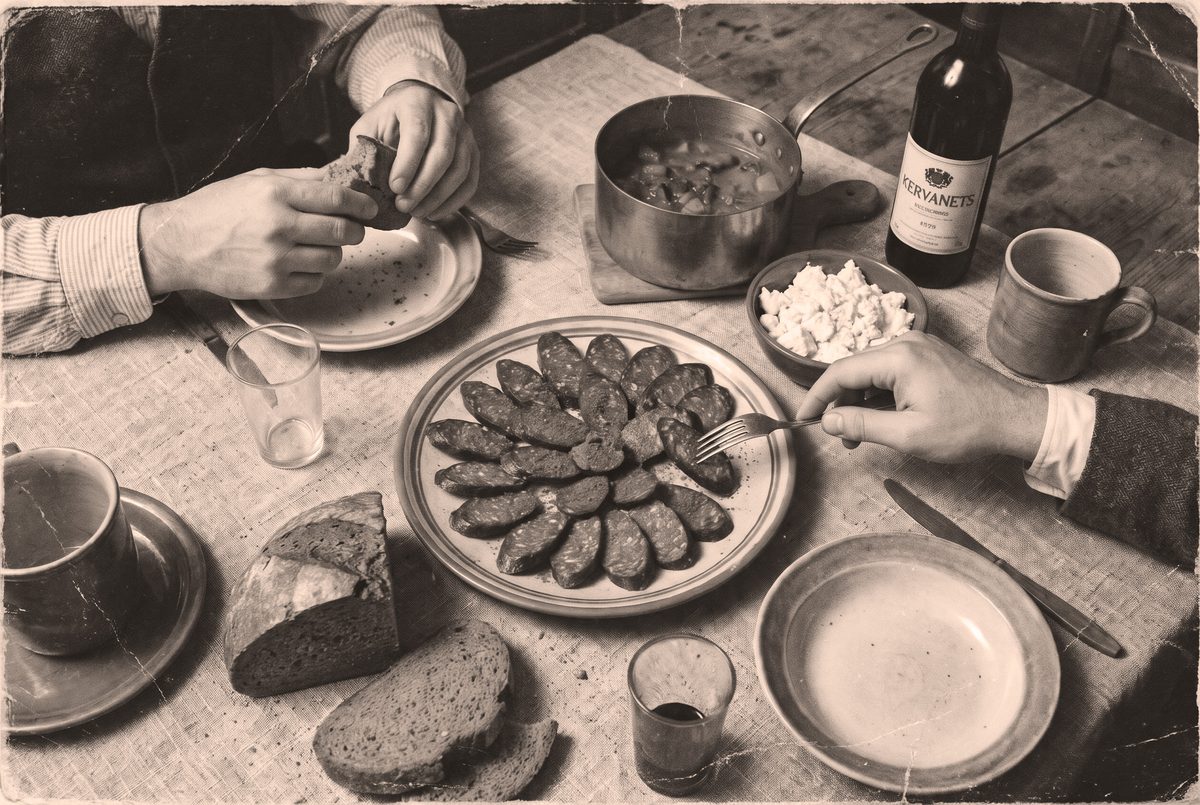
| *Sudzhuk* | Cured sausage, paprika, garlic | A winter store |
| *Lamb on a spit* | A whole lamb, 4 hours | A saint's day, a fair |
Cheese and milk [edit]
Two cheeses matter.
| Cheese | Content | Use |
|---|---|---|
| *Sirene* | White, salty, brined | Salad, pastry, every table |
| *Kashkaval* | Yellow, hard, sheep milk | A gift, a grill, a wedding |
A household with a sheep makes its own cheese. A town household buys sirene by the kilo and kashkaval at a feast.
Bread [edit]
Bread is the base of the table. A family eats 2 loaves a day and 3 on a feast.
| Bread | Shape | Note |
|---|---|---|
| *Hlyab* | Round, 700 g | The daily loaf. Dark flour |
| *Pita* | Flat, 400 g | A fast bake, a road food |
| *Pogacha* | Round, rich, 1 kg | A feast. A coin inside |
The coin in the pogacha brings luck. A person who finds it keeps it and buys a round.
Wine and spirits [edit]
| Drink | Content | Note |
|---|---|---|
| *Kervanets* | Red grape, dry, 12 percent | The state grape. The main export |
| *Bela Zala* | White grape, dry | A coast wine, drunk young |
| *Rakiya* | Plum or grape spirit, 40 percent | A morning glass, a guest, a funeral |
| *Mastika* | Anise spirit | A summer drink, with water |
| *Boza* | Fermented grain, sweet, low alcohol | A winter drink for a child |
The state wine enterprise makes 61 million litres in 1976. About half goes to the bloc.
|
Note:
|
The village wine
A household with 200 vines makes 400 litres. The state allows 100 litres for the house. The rest goes to the cooperative. The household keeps a second barrel in the cellar, and nobody counts it.
|
The canning industry [edit]
The cannery is a state industry and a part of the culture. A family eats a state can and it also fills a jar at home.
| Product | Brand | Export |
|---|---|---|
| Sprats in oil | Zora | Soviet Union, Poland |
| Mackerel in tomato | Zora | East Germany |
| Pepper relish | Skalina | Czechoslovakia |
| Sunflower oil | Zora | The bloc and Turkey |
| Jam | Skalina | The bloc |
A state can is a metal box with a paper label. The label shows a fish, a wave, and the plant name. See Art and Propaganda.
The copper pot [edit]
A copper pot hangs in most kitchens. The pot holds 6 litres and it cooks a slow dish.
A good pot is a wedding gift. A pot passes from mother to daughter. A pot with a repaired base is worth more than a new pot, because the repair shows use.
The table [edit]
A table has 4 rules.
- The eldest sits first and eats first.
- A guest sits at the right hand of the host. 3The glass rises only with a word.
- Bread is broken, not cut, at a funeral.
|
Notice:
|
Table line
"Na zdrave." (To health.) — the first toast, and the only one that needs no reason.
|
Coffee [edit]
Coffee is a hard-currency good. A family keeps it for a guest or a funeral.
A host serves coffee with a glass of water and a spoon of slatko. A guest who refuses the coffee refuses the house.
The morning herb [edit]
The morning table has a herb as well as a drink. Coffee comes from the port and costs hard currency. The herb grows on the hill and costs nothing.
A hill household bakes travenik at 05:00. A worker eats 2 slices with white cheese and a glass of tea.
| Form | Dose of zharkine | Who takes it |
|---|---|---|
| Travenik, 1 slice | 8 to 12 mg | Most adults, 2 slices a day |
| Zharka tea, 1 pot | 3 mg | An older person, the afternoon |
| The pastila, a concentrate | 40 mg | A prescription only, since 1976 |
The baker gets 40 kg of dry leaf a week from the cooperative. A town bakery with no leaf bakes banitsa and loses the trade.
The state calls the pie food and the pastila a drug. The law follows the same line. See Zharka and Zharkine.
A guest at a Moravskan table eats the pie and does not ask the name of the herb.
The meal times [edit]
| Meal | Time | Content |
|---|---|---|
| Morning | 06:30 | Bread, cheese, tea or boza, travenik on the hill |
| Midday | 12:00 | A canteen soup and a main dish |
| Evening | 18:30 | The main family meal, 2 dishes |
| The guest table | Any | 5 dishes or more, a bottle, coffee |
Shortage cooking [edit]
A cook works with what the shop has. Three habits come from the shortage.
- The substitute. A recipe uses margarine for butter and powder for milk.
- The stretch. A kilo of meat feeds 8 people with rice and onion.
- The store. A family keeps jars, salt, and flour for a bad week.
Other notes [edit]
See also[edit]
Sources[edit]
- Decree M. Dragova (1976). State Sports Council Decree 214. State Sports Council. SSC-1976-3144. Cited in The meal times, The table. See also Moravska.
- Statistical compendium J. Cornwell (1975). Comecon statistical yearbook, 1976. Comecon Secretariat. COM-1975-3204. Cited in Cheese and milk, The table. See also The Kervan Race.
- Register State Sports Council (1976). Parish register extracts, Tri Limana. Archdiocese of Zaligrad. ADR-1976-8649. Cited in The morning herb, Shortage cooking. See also Festivals and Calendar.
- Monograph Narodna Biblioteka Archivist (1973). Settlement and custom in Skalina. Zaligrad University Press. ZUP-1973-2852. Cited in The interior table, Coffee. See also Prozess Dokumentation.
- Oral history I. Petrov (1976). Oral history transcript, the Kray. Narodna Biblioteka Moravska. NBM-1976-5501. Cited in Cheese and milk, The canning industry. See also Moravska.
References[edit]
Documents in the archive that cite or cross-reference Cuisine:
- ^ "Festivals and Calendar". Rituals and Calendar, Narodna Biblioteka Moravska, 1976.
- ^ "Georgi Sapunov". People, Narodna Biblioteka Moravska, 1976.
- ^ "Leisure and Games". Arts and Leisure, Narodna Biblioteka Moravska, 1976.
- ^ "Moravska". Foundations, Narodna Biblioteka Moravska, 1976.
- ^ "Prozess Dokumentation". Meta, Narodna Biblioteka Moravska, 1976.
- ^ "The Kervan Race". Arts and Leisure, Narodna Biblioteka Moravska, 1976.
- ^ "Travenik". Arts and Leisure, Narodna Biblioteka Moravska, 1976.
- ^ "Vera Stankova". People, Narodna Biblioteka Moravska, 1976.
- ^ "Zharka and Zharkine". Society and Power, Narodna Biblioteka Moravska, 1976.